 My Italian grandmother made these all the time so I thought it fitting to serve them on one of her Florentine, painted wooden serving trays on the terrazzo table that sat on my grandparents’ patio for decades.
These crispy ribbons of pastry dusted with sugar are a sweet popular for centuries throughout Italy and across Europe and Asia. In Italy, they are traditionally eaten at the time of Carnevale, when cities, towns and villages celebrate their historical connections. The ‘chitter-chatter’ pop up under the guise of different names in different regions – chiacchiere, crostole, bugie, cenci, sfogliatelle, nodi, ali d’angelo, frappe, cioffe, galani, sfrappole…
Beware, for chiacchiere or ‘rumours’ can be addictive. They are best if light and flaky but still crunchy with some substance.
Ingredients:
- 450g plain flour {plus extra for kneading}
- 3 free range eggs
- 50g butter
- 100g caster sugar {raw, unbleached if available}
- 50ml Marsala {grappa or brandy may be substituted}
- 1tsp vanilla bean extract
- oil for frying
- extra caster sugar or icing sugar to sprinkle
Method:
- Sift the flour into a mixing bowl. Make a well in the middle and add the eggs, butter, sugar, Marsala and vanilla, mixing thoroughly to create a dough.
- Turn the dough out onto a floured surface and knead until smooth {dusting extra flour across surface to prevent sticking as needed}.
- Use a rolling pin or a pasta machine to roll the dough to lasagna sheet thinness.
- Cut into strips roughly 4-5 cm wide, or to your liking {an alternative is using a fluted, pastry/ pasta wheel cutter to give a crinkled edge}.
- Heat the oil in a deep frying pan and fry several strips at a time until they are golden.
- Remove with a slotted spoon and drain on absorbent kitchen paper.
- Sprinkle with caster sugar while still hot, or allow to cool completely then cover with sifted icing sugar.
Serves a good gathering chatting over coffee or sweet fortified wine.
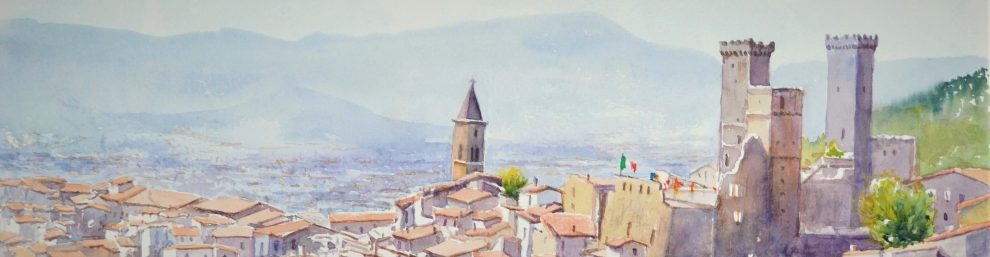
 Fossa house, Abruzzo, a decade ago… pecorino cheese made by two women on a farm down in the valley, olives from the L’Aquila market, cerasuolo wine from a nearby vineyard, the paisley tablecloth Nanna Francesca purchased from a travelling merchant who drove from village to village in his small truck full of wares, an Italian folk song blaring from speakers to notify buyers he had arrived.
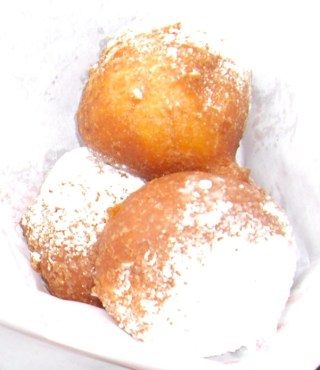 These little doughnut balls are also known as zippoli, zeppole or sfingi in Italy depending on the region where they are cooked. (I’ve also tasted the German version quarkbällchen – known too as ‘Bavarian snowballs’ – from a roadside stall not far from
  On a Sunday afternoon walk, we discovered mulberry trees growing wild along the creek and were not the only ones who picked the berries – the largest, plumpest and sweetest we’d come across in ages. Almost half an hour later the trees were still heavy with fruit, plenty left to share with others, the birds and flying foxes. That night Roger made mulberry pie with crumbly, buttery shortcrust pastry for supper. A little bit of ‘Sunday afternoon’ to last throughout the week…
 Saw these sweet, baby capsicums at the market and couldn’t resist buying them, though I wasn’t sure how I was going to cook them. Decided to stuff the capsicums with a mixture of seasoned goat’s cheese, pine nuts, parsley and basil, then bake in the oven. Served with some crusty bread on the side…
 The Lucini macaroni factory (circa 1859) is said to be the oldest building in Australia built by Italian-Australians. There are 150-year-old frescoes inside that unfortunately remained hidden as it was closed the day we came by. Sitting in the main street of Hepburn Springs in Victoria, the building was also the location for Jan Sardi’s film,
 It is claimed that arancini originated in Sicily as far back as the 10th century. The balls of rice with various fillings are shaped, crumbed and fried, resembling an orange – the Italian for orange being arancia. (Rice cooked the day before and cooled in the fridge works best.) In Messina, they can be more cone shaped, while in Naples they are pall’e riso (rice balls) apparently. I think ours (made 11 centuries later in Australia!) ended up being influenced a little by both cities.
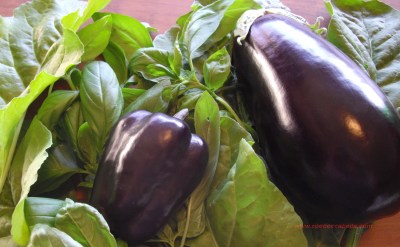

 So far about half a dozen at last count in the vegie patch. Every day I see them getting a little larger. I cannot wait to cook them and am trying to think of different recipes – eggplant parmigiana, crumbed slices fritte, melanzane involtini, stuffed eggplant, melanzane in passata…
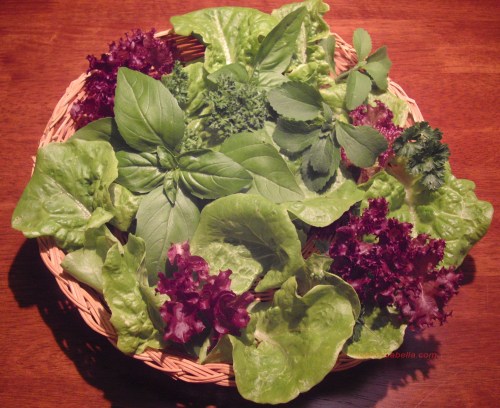 I know it’s a modest harvest yet I was thrilled to pick the first greens grown in our kitchen garden and make a salad for lunch with red and purple lettuce, parsley, basil and stevia leaves. I also added some cherry tomatoes (from the farmer’s market not the vegie patch, though I noticed the tomatoes I planted have some baby ones starting to form!)
 Pane Casereccio – delicious served warm – R made this Pugliese bread studded with salami and cheese, inspired after watching an old television series with Antonio Carluccio making it. I love how so many Italian recipes have been created to use leftovers.
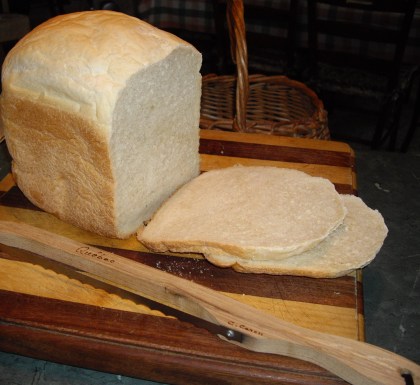 “…whenever the loaf is put on the table, few foods will produce such joy and delight in others as when freshly baked bread appears, the aroma of fresh memories rising with every slice, and all things – poetry and miracles, friends and family, food and love – for a short time are as they ought be: one.”
 At home when I was growing up, we sometimes ate eggs baked in leftover pasta sauce which we called, ‘eggs in tomato’, not quite as evocative as ‘eggs in purgatory’ that I later discovered this dish is also called.
 il bouquet perfetto for Valentine’s Day
 Caggionetti/calcionetti are traditional Italian Christmas treats particularly popular in Abruzzo (where my Granny Maddalena made them). They have a filling of almonds, walnuts, chocolate, chickpeas, lemon zest, cinnamon and honey enclosed in paper-thin ravioli casings fried in white wine and olive oil then cooled and dusted with icing sugar.
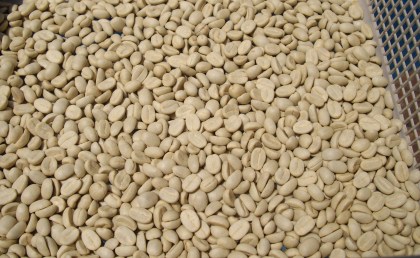 Next step in the coffee process – the beans (or seeds) from inside the coffee cherries have been washed and are now drying.
 It’s coffee harvest time again… these we picked from our backyard tree. Then, by hand, R extracted the beans from inside the coffee cherries and the beans are now spread out on wide sieves drying.
 It may not be the prettiest dish but the fried slices of eggplant rolled like crepes around prosciutto and mozzarella then baked with tomatoes, Parmigiano and basil tastes divine.
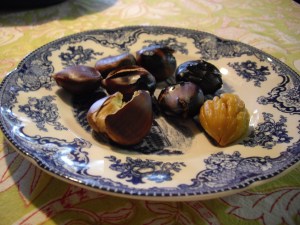 Autumn means chestnuts, castagne and I always think of my Italian grandfather, Nonno Anni whenever we roast them. In the Abruzzo in the 1930s, Nonno Anni harvested chestnuts beneath Gran Sasso, later taking them to turn to flour at the stone mill with the wooden water wheel on the canal below his village of Fossa.
 For many centuries, baking in most Italian villages took place mostly once a week or even a fortnight. Both my grandparents told me how they recalled the women of the village taking their dough to the forno (often the only oven in the entire village), and that each piece of dough had an identifying mark on it for when the women came back to collect their baked bread.


 Zoë Boccabella