
 It’s Capetièmpe in Abruzzo – that special time of year from all hallows eve for about twelve days when the kitchen table is laden with delicious food from harvest time and places set for both the living and the dead. When there are candles and bonfires of endings and renewal, picnics in cemeteries and masked children go to each house collecting treats from the laden tables to share with their poorer families.
Whether it’s called Capetièmpe, Samhaim, Halloween, Totenfest, Day of the Dead or other names in different countries or parts of Italy, it’s about remembering those from the past especially loved ones, honouring nature’s cycles and keeping in mind that time isn’t necessarily linear. It can also be a circle, an endless cycle of events, the sun and moon constantly rising and setting.
Dawn, day and night. Rain onto land, into rivers and the sea, then up into clouds again. In church frescoes, old photographs, recipes cooked over and again. The cypresses in so many cemeteries, planted because they represent eternity, endurance, resilience – reaching from the earth to sun and sky. Nature’s calendar always a part of life, whether in rural or urban places, modern or ancient times. Remembering and honouring who we’ve known, what we have and what may come. 🖤🌿
 On the kitchen table today… poppies! I happened to see these when I was getting groceries and couldn’t resist picking up a bunch. At once they made me think of being in Abruzzo in spring and seeing the hillsides covered in these flowers growing wild.
 Thank you for joining me here throughout the year – for your wonderful interest in and support of my books and for sharing your own experiences and memories with me.
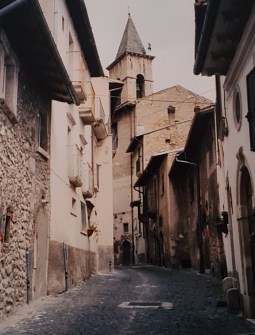
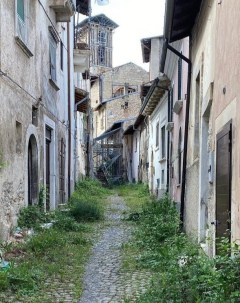 If you have any link to Abruzzo, I warn that this footage may be hard to watch as those filming go right into the most intimate parts of homes, which may just happen to be yours or of someone you know. That said, the young men filming have done so with respect, have only entered houses where the doors were already open and have concealed the name and whereabouts of the village. (Considering my own family’s house is one of those looted since the earthquake, I appreciate this.) By the end, they also appear to be overwhelmed by all they’ve seen.
 Received this lovely gift from a reader, Augusto (who doesn’t mind me sharing that he lives in Australia, was born in Fossa, Abruzzo and was pleased to discover the books). At 80, for the first time he’s learnt copper smithing and made me this little, copper conca and ladle, like those larger ones traditionally used in Abruzzo to collect water (women like my bisnonna Maddalena carried them on their heads).
 Thank you to Augusto, such a beautiful kindness. I will treasure it always! And many thanks to all who’ve connected through messages and letters. It’s such a pleasure to hear from you. What most drives me to write is to preserve experiences of ‘everyday’ people and their often overlooked yet I believe significant parts of history. Thank you for your interest (and I’m working hard on the next book!!) xx
 This hillside speckled with wildflowers could perhaps be out of Little House on the Prairie but is in Abruzzo (where, incidentally, many spaghetti westerns were filmed in the 1960s and 70s).

 With Nanna Francesca and Nonno Anni outside the family house in Fossa when I arrived there for the first time all those years ago (bearing in mind by then I’d been travelling and living out of a backpack for several months!!)
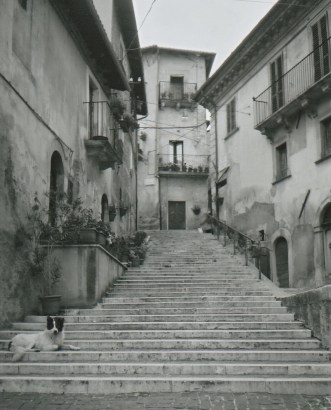
 Coming up this street in Fossa always feels like being ‘almost home’ whether returning from nearby L’Aquila or a long flight from Australia. For just around the next corner is my family’s house and while it has centuries of history, to me it also has that comforting feel like coming to stay at your grandparents’ house.


 … at around dawn while most of the village still slept.
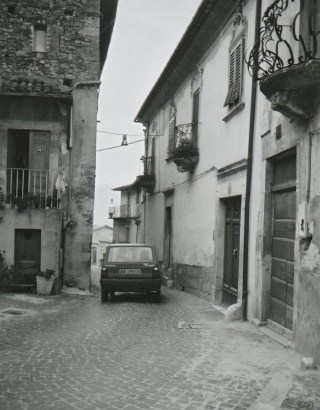
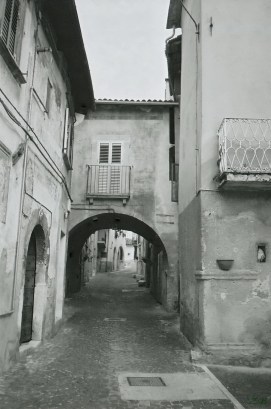
 I took this from the tiny balcony of the house in Fossa. As Roger walked along the laneway below on his way to the Boccabella shop and passed someone on their phone, he had no idea I was taking a photograph from above.
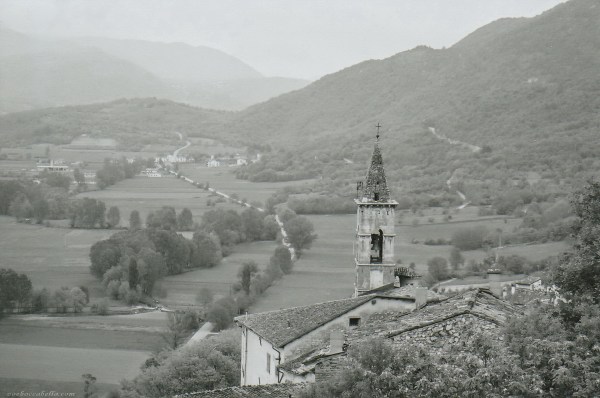 The steeple of Santa Maria Assunta in Fossa… the church that sits opposite my family’s house in Abruzzo. It was lovely to walk along the lanes below and listen to the bell tolling the time of day or to hear it from afar when you were on your way back to the village.
 This window in the small house in Italy, that has sheltered different generations of my family for centuries, is my favourite. It is the tiniest and gives a view out over the village of Fossa like peering from a cubby house. I also love that it shows how thick the stone walls are.
 Fossa house, Abruzzo, a decade ago… pecorino cheese made by two women on a farm down in the valley, olives from the L’Aquila market, cerasuolo wine from a nearby vineyard, the paisley tablecloth Nanna Francesca purchased from a travelling merchant who drove from village to village in his small truck full of wares, an Italian folk song blaring from speakers to notify buyers he had arrived.
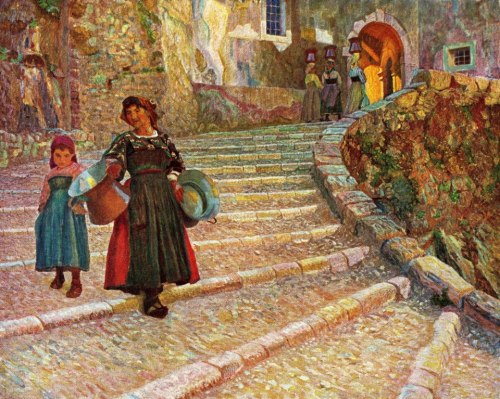 The woman in the foreground carries two conche, the copper vessels traditionally used in Abruzzo to collect water from the village fountain for the household. Perhaps she was teaching the young girl to carry it back on her head (depicted by the women in the background). The village women used to do so to transport all manner of heavy things with evidence of this including iron bedheads and, on occasion in very steep areas, even coffins.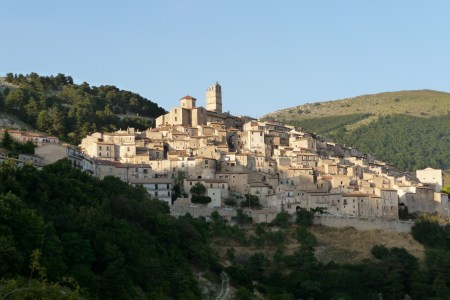

 It’s ‘Giro time’ again in Italy at the moment. {4-26 May, 2013}
 At home when I was growing up, we sometimes ate eggs baked in leftover pasta sauce which we called, ‘eggs in tomato’, not quite as evocative as ‘eggs in purgatory’ that I later discovered this dish is also called.

 The Maremma Sheepdog is indigenous to central Italy, particularly Abruzzo and the Maremma area in Tuscany and Lazio, and has been used for centuries by Italian shepherds to guard sheep from wolves.
 Caggionetti/calcionetti are traditional Italian Christmas treats particularly popular in Abruzzo (where my Granny Maddalena made them). They have a filling of almonds, walnuts, chocolate, chickpeas, lemon zest, cinnamon and honey enclosed in paper-thin ravioli casings fried in white wine and olive oil then cooled and dusted with icing sugar.

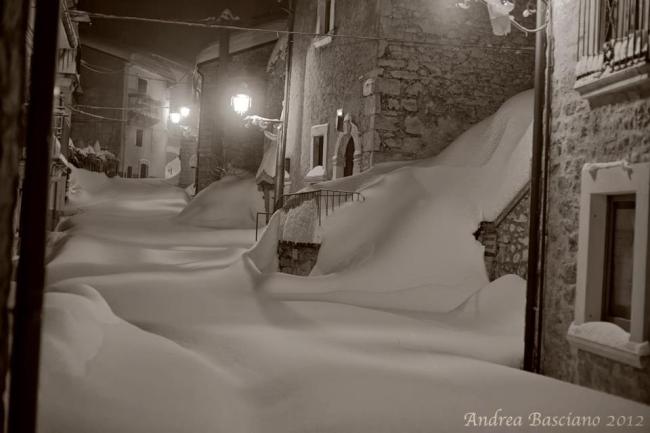
 This painting of Fossa in the Abruzzo is by artist Juan Alfredo Parisse, born in Buenos Aires, Argentina, and whose parents are from L’Aquila, Italy.
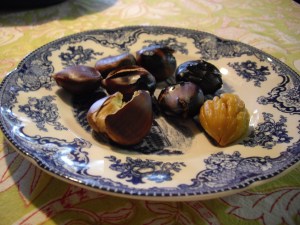 Autumn means chestnuts, castagne and I always think of my Italian grandfather, Nonno Anni whenever we roast them. In the Abruzzo in the 1930s, Nonno Anni harvested chestnuts beneath Gran Sasso, later taking them to turn to flour at the stone mill with the wooden water wheel on the canal below his village of Fossa.

 For many centuries, baking in most Italian villages took place mostly once a week or even a fortnight. Both my grandparents told me how they recalled the women of the village taking their dough to the forno (often the only oven in the entire village), and that each piece of dough had an identifying mark on it for when the women came back to collect their baked bread.
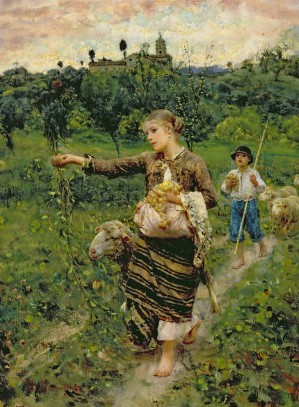 Born in 1851 in Tocco da Casauria of Pescara province, Francesco Paolo Michetti was an Abruzzese artist who aspired to paint ‘real life’ capturing people, animals, and local events. The Abruzzo was his inspiration and in 1883 he purchased a convent there as his home and studio. For the next 20 years, the convent was a meeting place for Abruzzo’s artists including writer Gabriele D’Annunzio. Time moves slowly in the Abruzzo and fortunately some landscapes such as in this painting remain.

 Zoë Boccabella