A lovely surprise to hear of this article in Il Capoluogo that talks about my books. You may read it in Italian via this link or the English-translated version below. Some of the translation from Italian may come across a little differently in English. Interesting to find out how some of my posts are interpreted from afar, especially in Italy. (And in line with the article’s title, I can say that despite earthquakes, pandemics and all else that has kept me from the family house in Fossa, I still love the beauty and history of Fossa, the Aterno Valley and Abruzzo and now that I’ve finished, The Proxy Bride, I’m delving back into this remarkable area of Italy and some unanticipated family trails for my next book.) Many thanks to giornalista, Sergio Venditti for the article.

PERSONAGGI
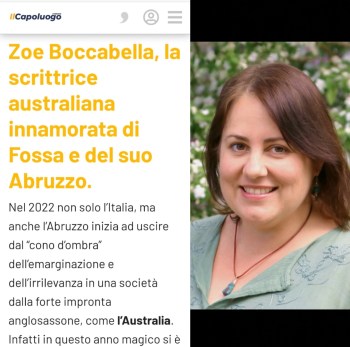
Zoë Boccabella, the Australian writer in love with Fossa and its Abruzzo.
by Sergio Venditti
In 2022, not only Italy, but also Abruzzo begins to emerge from the “shadow cone” of marginalisation and irrelevance in a society with a strong Anglo-Saxon imprint, such as Australia. In fact, in this magical year a real political-institutional miracle took place with the election as Prime Minister of that great country the Hon. Anthony Albanese, son of an Apulian from Barletta (known only in 2011) and raised by a single mother. An outcome that was not taken for granted, with the victory of Labor, after a decade under conservative leadership, but who wanted to experience change in the post-pandemic. The Albanian government has thirteen ministers, even with a representation of Islamic faith. At his oath, the Prime Minister declared, “I am proud of my government, which reflects Australia in its inclusiveness and diversity”.
Of course, half a century has passed since that film by L. Zampa (“A Girl in Australia” starring C. Cardinale and A. Sordi), which made an era: “Handsome, Honest, Australian Emigrant would marry a respectable countrywoman”. The critic G. Grazzini wrote about the film: “It is not only fun, it evokes the nostalgia for the distant homeland…. where everything is possible “. In fact, in recent decades the Italian community has conquered, with tenacity, a central space in Australian society, as already highlighted in all fields.
 This is also the case for an emigrant like Annibale, who arrived in the country from his small village of Fossa in the province of L’Aquila. Childhood memories of him are now inspirational for his granddaughter, Zoë Boccabella, an emerging author. The latter reports her family background in the book: “Mezza Italiana“, featured in a 2019 interview (to Abruzzo Economia): “I grew up as a descendant of Italian immigrants in the 70s and 80s, when having Mediterranean origins it was not as well regarded as it is now”.
In this autobiographical book, Zoë describes her discovery of Abruzzo and her home in Fossa (damaged in the same 2009 earthquake). In these memories, Boccabella touches the central heart of the return to the origins: “The first time I travelled to Abruzzo, where my paternal grandfather comes from, I had the feeling of returning home”.
Thus visiting Calabria itself, from which her grandmother came. And again memory becomes writing: “Walking through villages, hills, woods and abandoned castles, I felt that Abruzzo was a unique land” and … “I was reflecting more and more on my life experience … and on how I felt divided in half, as if I did not entirely belong to either culture”.
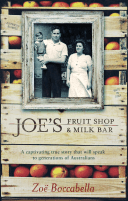 A journey to rediscover her origins after growing up in Brisbane (in the Australian north-eastern state of Queensland). “I started writing what would become Mezza Italiana, while I was sitting at the kitchen table of our family house in Fossa”. Still in the kitchen, this time in Australia, Zoë describes: “pumpkins, which we bought from a farmer, along the road, near Esk”. And after also their symbolic role in the land of the ancestors: “For centuries in Abruzzo pumpkins have remained a significant part of folklore and the agricultural calendar, with late autumn, which was a moment of reconciliation and gratitude at the end of the harvest” … “With the end of the seasons the arrival of the moment of gratitude for those who preceded us, who have now disappeared”.
“The cocce de morte” (heads of the dead), are carved in the pumpkins and inside with a lit candle to illuminate, welcoming the loved ones of the past, to join those present and their homes “. In this, Zoë Boccabella represents a cultured writer (with a degree in Literature and Sociology, with a master’s degree in Philosophy), determined and coherent in her narrative plots.
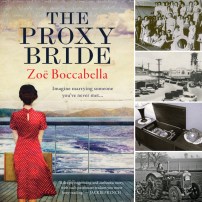 Now she announces her third book, forthcoming, entitled “The Proxy Bride“, which takes up the old custom of proxy weddings in a foreign land. An extraordinarily lively novel, “About family, secrets and adversity, imagining marrying someone you’ve never met. How she arrived in Australia on a bridal ship, among many brides by proxy, knowing little of the husbands they had married from afar, most of them coming to find someone, very different from what was described “.
The author recalls the same added value of feminist culture, in “Three Shades of Mimosas“, as a symbol to celebrate the first International Women’s Day, in 1946. A shared appeal also to denounce the Russian invasion, the loss of many paintings by the Ukrainian artist M. Prymachenko (1909-1997), with her symbolic work, “A Dove Has Spread Her Wings and Asks for Peace”, 1982. Yet a great Russian literature like F. Dostoevsky wrote: “Man loves to build and trace roads, he is peaceful. But where does it come from that you also passionately love destruction and chaos”.
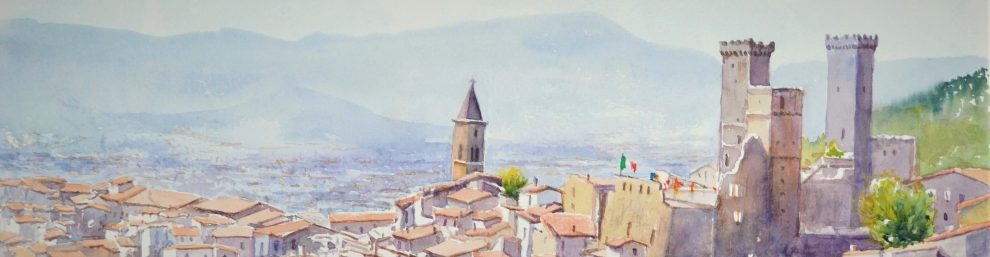
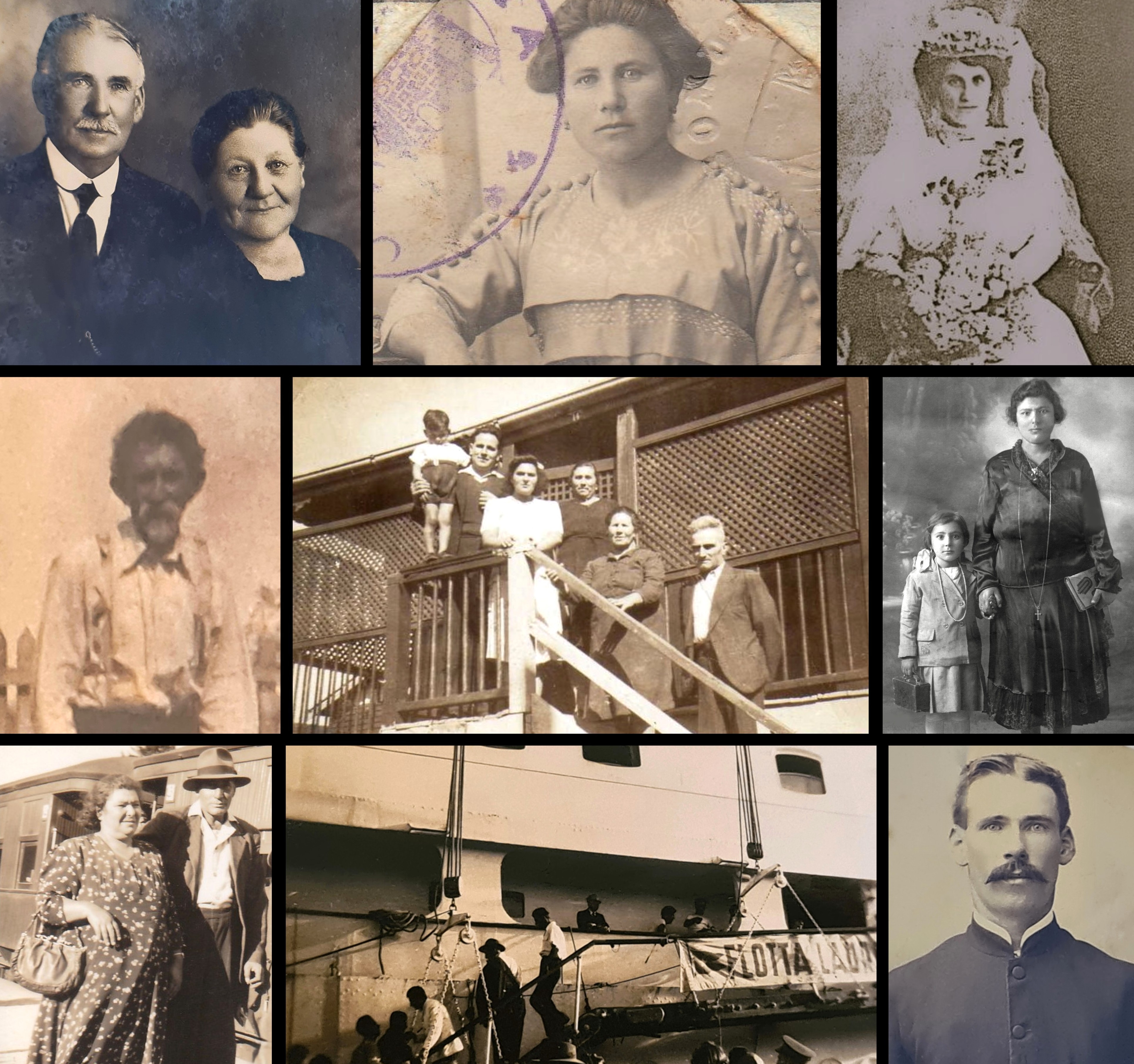 Whether it be from my past books or as I continue learning of and writing new stories for the next book, one thing that keeps showing itself over and again is that migration has many stories and different faces, even just in my own family –
 Nanna Francesca with my dad (far left) and other residents at 157 Leichhardt Street, Spring Hill, inner-city Brisbane. For several years, one of the flats here was my grandparents’ home when they first started their fruit shop and milk bar. ‘Stonehenge’ – with its flats and serviced rooms where so many migrants, especially Italians, stayed ‘when they first got off the boat from Italy’.
 The wedding bonbonniere trinkets in Nanna Francesca’s ‘good’ cabinet were out-of-bounds when I was a kid. Though I’d look at them through the glass, some still with the teeth-cracking sugared almonds – confetti, as they’re called in Italy – that represent ‘health, happiness, wealth, luck and fertility’.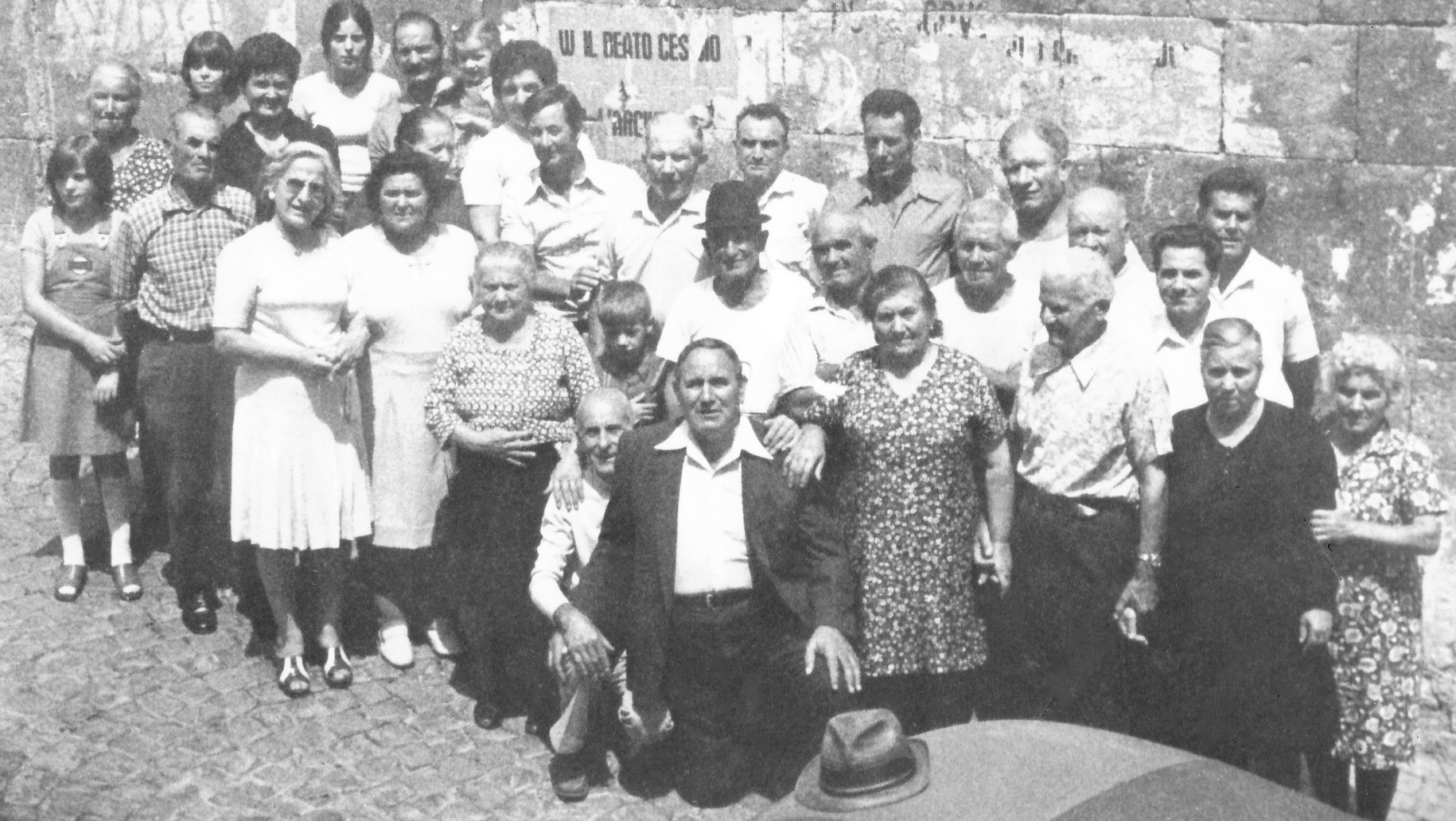
 Also, since I mentioned in my last post that Nanna Francesca would’ve been especially happy to see, The Proxy Bride in the Australian Women’s Weekly, I thought I should mention the same might’ve been for Nonno Anni regarding a recent article about my books appearing in the Italian Australian newspapers, Il Globo and La Fiamma (full article in Italian online). I have lovely memories of him at the kitchen table often reading one of these newspapers with a morning coffee (International Roast boiled on the stove in the enamel pot, of course!)
 A post script – there were too many little incidents to include them all in,
  Perhaps I was a bit too sentimental in my previous post, (I can be at the best of times!) It might’ve been because Wyandra Street features so strongly in my family history and now, little remains of how the area once was and another bit will soon vanish. But I accept life keeps going on, change happens and so it is. In the meantime, we connect and live on in our stories and I feel very blessed to be able to share these stories with you and to hear yours in return. Gentile auguri! Zoe xx
 The Proxy Bride is a novel inspired by true stories and set between the 1940s and the 1980s in Italy and Australia. There will be angry spaghetti, mixed grills, mixed tapes, Dean Martin on the 1950s stereogram and plastic on the lounge suite and, above all, hopefully characters you may come to love who band together amid tough times for a new life.
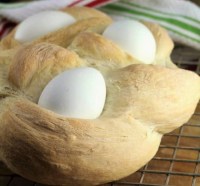 Colomba cakes are mostly bought and Nanna Francesca used to make a more modest Easter bread with hard-boiled eggs baked into it. This year I broke with tradition and made an ‘Easter lasagne’ for the family. It has been a rainy day so it seemed the thing to cook.


 Zoë Boccabella