Tag Archives: Italian folklore

La bellezza dell’acqua…

Years ago, when it wasn’t common to have running water at home in Abruzzo, on the first day of a new year, women would go to the village fountain to collect clean water in their copper conca or basin and take it to friends and neighbours as a gift.
They would deliver it with a saying, “Buongiorno e Buon Capodanno, questa è l’acqua pulita che ti porta un inizio pulito per il nuovo anno.” – ‘Good morning and Happy New Year, this is the clean water that brings you a clean start to the new year.’

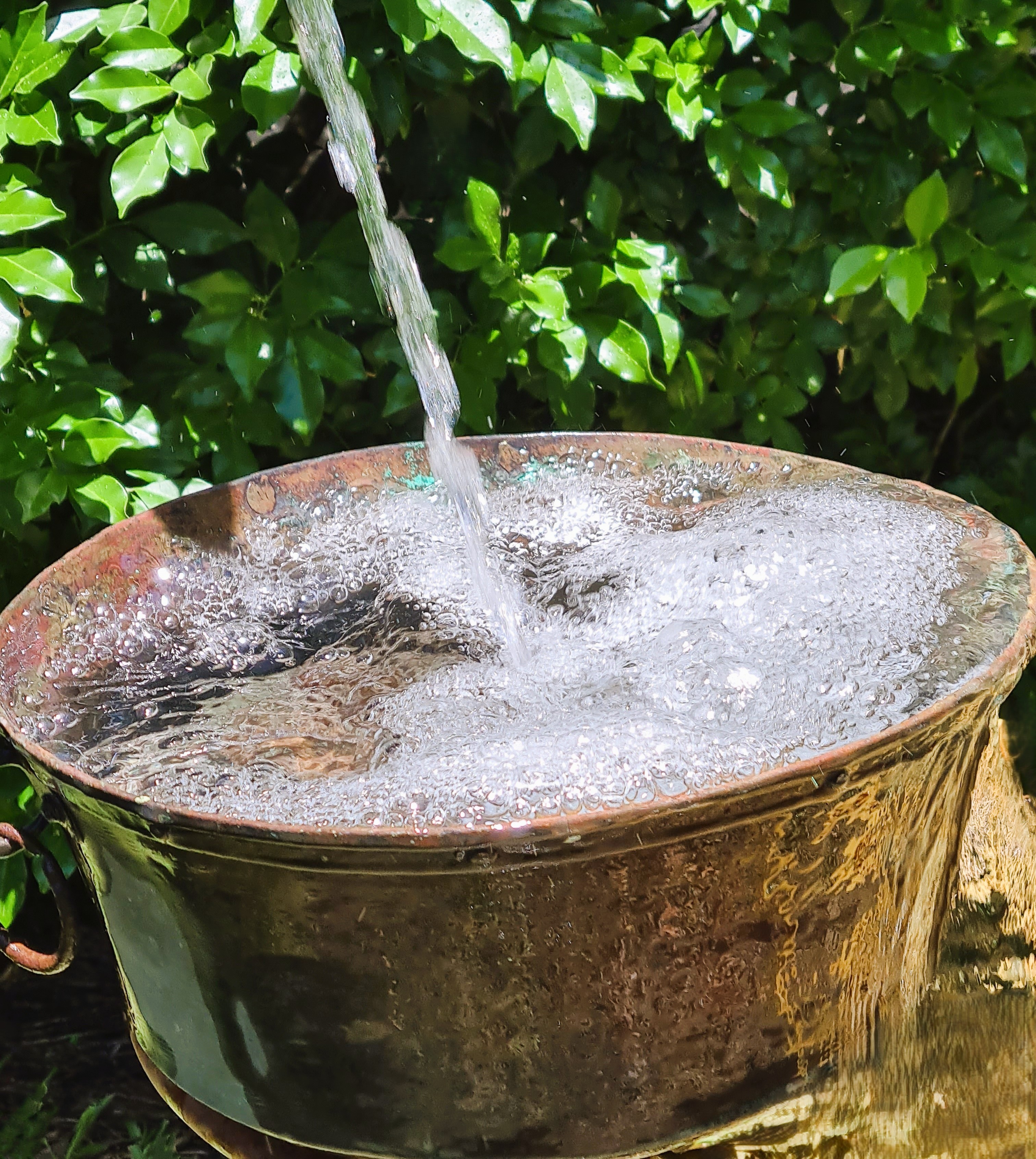
In honour of this tradition and taking in my ties to both Australia and Italy, I poured Australian water into an Abruzzese basin (not a conca but my great-granny Maddalena’s copper cooking pot that she brought all the way to Australia from Abruzzo).

The gushing cold water bubbled in the hot sun and I felt hopeful for a clean and fresh new year. To wash away all that’s not kind or respectful, to embrace the gentle, thoughtful and giving, and also, to be thankful for those who bring this to our lives. The basin was poured out to water a little tree and so the new year begins… Buon anno. ✨🌳 Zoe x

Leave a comment

Filed under inspiration + history, italy

Corajisima and her spindle…

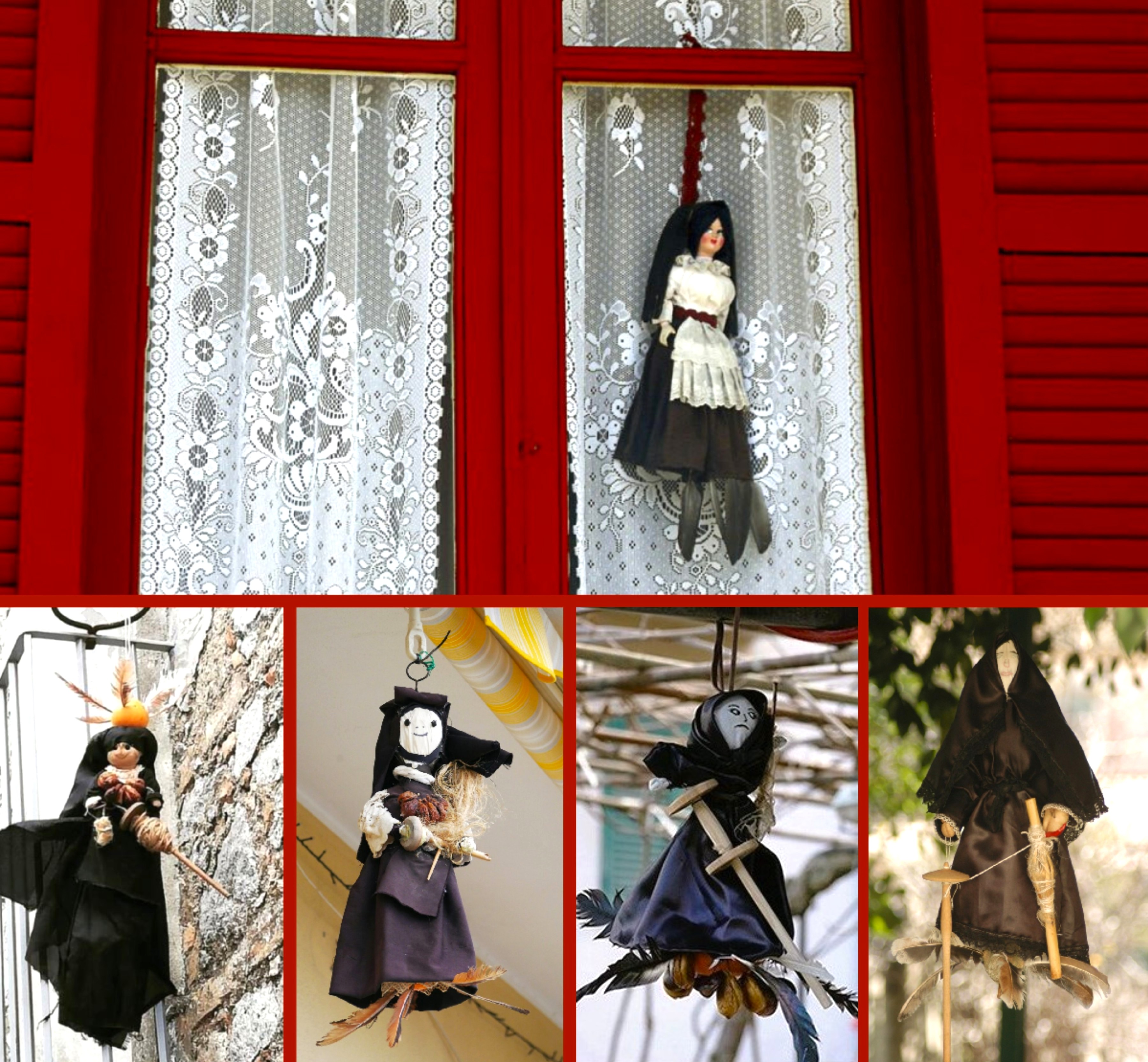
Corajisima – ‘the widow of Martedì Grasso’ (the last day to eat all you want before abstaining during Lent). Then, from midnight, Corajisima roams the streets with boiling water to burn the throats of whoever dares to eat meat or sweets.

In southern Italy, hanging a handmade Corajisima effigy in windows or at doors is to remind it’s currently the Christian Lenten ritual of fasting and sacrifice and she’s come to appear as a skinny, old, ugly woman in black with feathers, fruit and a spindle.

However, originally, she was quite different. Since ancient times the effigy of a woman with fruit, feathers and spinning tools has been used in both old, Italian folklore and paganism to symbolise transformation and the earth reawakening. A lovely, comforting figure to encourage perseverance until the full arrival of spring.

I happen to have a doll (just like the one in the pretty red-painted window with its lace curtain) that Nanna Francesca gave to me as a child (yes, this doll is still in my cupboard!) Yet, Corajisima and this tradition wasn’t carried on after she and her mum emigrated from Calabria to Australia and it’s sobering to think of emigration ending a tradition so very old. Perhaps come spring in Australia, I should bring out this doll and find some feathers and a spindle?! (Spindles were a big deal in Abruzzo folklore too.)

Whatever might be thought of these old rituals, to me there is something quite incredible in how they’ve survived thousands of years, to evolve or be hijacked, yet are still ongoing. And it’s wonderful to think this one was originally a figure to encourage perseverance until the arrival of better times, a time of transformation and reawakening. ❤️🍊🧵🌿

2 Comments

Filed under inspiration + history, italy

Epiphany Eve… ✨

Tonight’s the night Befana comes to visit, leaving children in Italy sweets if they’ve been good and coal if naughty. These days she’s depicted as a ‘witch’ who visits on the twelfth day of Christmas, coming down chimneys to deliver her gifts (and yes, she was about long before a certain jolly fellow). Incredibly, her origins are tied up in Italian folklore for more than two thousand years, and not only that, but with links to Abruzzo.

Initially, Befana was known as Strenua or Strenia, an ancient goddess of the new year for the Sabines in central Italy’s Apennines, and then for the Romans too. As early as 153BC, records show sweet gifts of dates, figs and honey were exchanged in her honour for the coming year and twigs carried from Strenua’s fertile grove in procession.

These ‘twigs’ likely later became a broom when she was morphed into Christianity as an older woman busy sweeping her house when the magi, three wise men stopped by en route to see the new-born Jesus. The ‘sweet gifts’ becoming those Befana gave children after regretting being too busy working to join the magi. She set out later but, unable to find them or the baby Jesus, instead left her gifts for other children.

Over time, Befana became depicted as more witch-like, travelling by broom, her gifts not only sweets but also coal (yet still valuable for heat in winter, a gift shared with all). I’ve a soft spot for witches, especially those who are healers and an integral part of village life. I’m perhaps biased since my Bisnonna Maddalena was one of Fossa’s witches, but I can’t help feeling it’s unfair how these older knowledgeable women over time became portrayed as uglier and uglier, including Befana.

Lessen the hooked nose, pointed chin, warts and pointy hat and the ‘witch’ is a woman, with years of experience behind her. A nonna, mother, aunt, the lady next door – women who’ve aged with grace, hard work and all that happens over time when blessed with a long life. A woman, perhaps familiar, older, living alone, cleaning her house, making sweets as gifts and quite beautiful in her lined face and her kindnesses. A woman like Befana.

Epiphany is still celebrated in many countries around the world and it’s lovely (and quite incredible in a way!) that in Italy, Befana remains a part of it and held close more than two millennia on. Viva, viva la Befana. Buona Epifania! 🌠

Leave a comment

Filed under inspiration + history, italy

the sewing box…

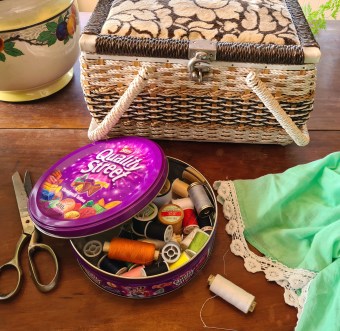
Mending… so out comes the sewing box Nanna Francesca gave me for my 8th birthday. I can’t tell you how disappointed I was to receive this as a present at that age, though I put on a happy face so not to hurt her feelings. Afterwards, I told Mum she could have it and the sewing box sat in her linen press for years. Yet, once I moved into my own house, I went and retrieved it and it has stayed with me.
I’m not much of a sewer like my grandmothers and great-uncle were. I can only mend hems or sew on buttons by hand. In first year high school, when all us girls had to do ‘Home Economics’, I liked the cooking (we made scones and shepherd’s pie) but didn’t take to sewing. I think I lacked the patience and neatness needed. It was Mum, in exasperation – ‘You should at least be able to mend a hem and sew on a button!’ – who showed me.

The white thread I’m using was hers. All the other spools also Mum’s or my grandmothers’. The scissors, a bit blunt now, were Nanna Francesca’s, and Quality Street chocolates I’ll always associate with having at her house. I know I’m terribly sentimental but it’s nice to be reminded of these connections on the odd occasion I get out this old, sewing box.

Even this sundress I’m mending is old and faded but its cool cotton is perfect as a ‘house dress’ in summer. I recall women in Italy sitting on chairs outside their doorsteps, mending clothes or linens (to me, a comforting sight). Partly, such mending stems from necessity, especially in poorer areas, however in Italian folklore there’s also an awareness and valuing of the fleeting nature of certain earthly materials we use. Like linens or timbers that bear the effects of sun, wind, human treatment, rain, marks, stretches and shrinks in their histories of use and misuse. Things that may not be financially worth much, but worth being mended for as long as they may be used.

Once I would’ve been too self-conscious, but I think if I was in Italy, I’d now drag a chair outside the door while I sit and hem, catching the breeze and perhaps a chat if someone happened to stroll by… 💚🧵

2 Comments

Filed under inspiration + history

Spring circles…

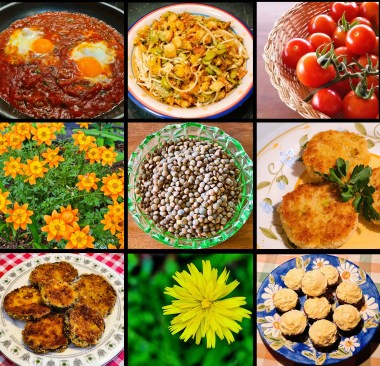
Spring circles in the kitchen and garden – eggs in purgatory, ‘lucky’ lentils, broad bean risotto fritters, a dandelion flower, melanzane fritte, orange patty cakes, fava spaghetti with spring greens…

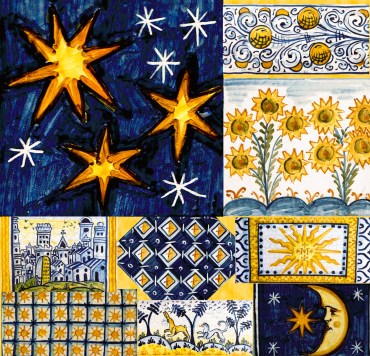
Circles are significant in Italian folklore – the symbolism of the sun that makes things grow, the wheel of life slowly turning, the seasons in a constant cycle circling around through the dark and cold and back to light and warmth once more.

I think of Granny Maddalena’s leathery, work-worn hands sorting through the lentils to remove any tiny stones. I feel the light smoothness of lentils in my own hands now as the wheel continues to turn. Auguri fortuna e felicità questa primavera – wishing you luck and happiness this spring. 💛 Zoë xx

Leave a comment

Filed under kitchen stories

Fennel flowers, folklore and little stars…

On the kitchen table… fennel flowers, their little blossoms like star bursts with a slight scent of liquorice, honey and lemon. I came across some fresh fennel bulbs at the market about a month ago but life has taken over for a bit since then! These fennel were irresistible in their curviness. (Male fennel are slimmer, the female fennel more rounded and sweeter – said to be ‘like the many beautiful, curvy women of the Mediterranean shores these plants are indigenous to’!) 😘
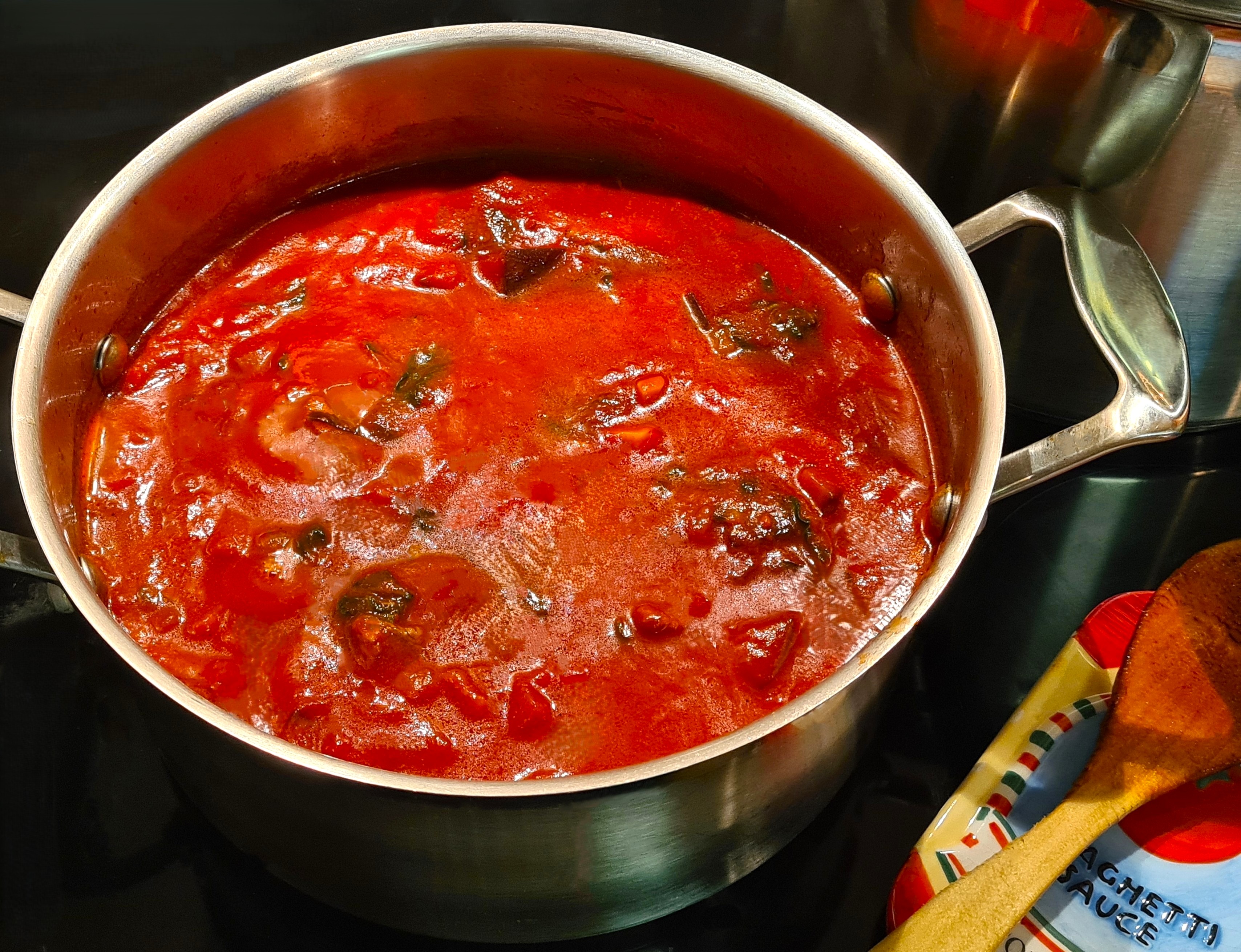
I thinly sliced a fennel bulb, drizzled it with olive oil and baked it with prunes and a glug of Marsala wine. (The one with ‘the little cart on the label’, as we call it.) Boronia Marsala is described as ‘an Australian vino dolce that pays homage to its Italian origins’ so it seemed appropriate. If it was summer here, I would’ve left the fennel raw and tossed it with orange segments, olive oil, salt and pepper for a delicious, fresh salad. After eating either of these dishes, no need, I think, for any ‘Milk of Magnesia’ (for those who’ve spied the old blue bottle the fennel flowers are in!) That said, the sentimental side of me loves how the flowers are like a starry sky next to this luminous, blue glass.

Nanna Francesca would probably guffaw and shake her head at me putting fennel flowers on the table. Though, I wonder if Great-Granny Maddalena might’ve approved considering she’d collect greens including wild fennel from the hillsides in Abruzzo and carry them in her apron back to the kitchen. Funny how our ancestors often seem to be with us in many ways long after, for both the good days and also the harder ones that can be downright difficult. Granny Maddalena, a great believer in Italian folklore, would likely say, “Fennel gives strength and courage…” then swiftly follow that with, “and it keeps out evil spirits if you stick some in the keyhole!” 💙🌿 Zoe x

4 Comments

Filed under inspiration + history, kitchen stories

Stars, circles and crosses…

Thank you for joining me here throughout the year – for your wonderful interest in and support of my books and for sharing your own experiences and memories with me.
For me, the best part of writing is the connection when those words are read or heard and that magic happens of a story shifting from one mind to another. I love this also when you share your own stories with me. Grazie e auguri. xx

I understand all too well that this time of year can be one of joy, challenge or mixtures of both and my heart goes out to you all. Whatever your beliefs or experiences may be, I hope this time rests gently on you and that the coming year is a kind one.

Warmest wishes, baci e abbracci, Zoë 💙  x

* Pictured are painted tiles from the San Donato ceiling, 1615, in the village of Castelli, Abruzzo that lies on Gran Sasso, the highest mountain of the Apennines. The 17th century stars, circles, suns and crosses actually go back much further to ancient times in Italian folklore and are part of a little of the magic of the area that I’m hoping to write about in the coming year.

9 Comments

Filed under inspiration + history, italy, old photographs + art

Italian folk magic and amulets…

Raccavallala!’ Granny Maddalena cried out if someone stepped over a child lying on the floor – step back over it! – or you’d stunt the child’s growth. I’m currently researching Italian folklore and came across this very superstition and many others like… never put your wallet on the floor or you’ll have no money. If you accidentally put your clothes on inside out in the morning it’s good luck and you’ll receive good news. Wasting food or throwing it out brings misfortune. Remove cobwebs with your left hand for good luck.

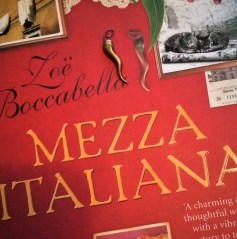
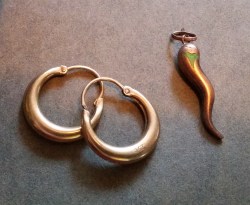
On the cover of Mezza Italiana is Granny Maddalena’s actual corno amulet from Abruzzo that she wore on a delicate gold chain. Made of a gold likely from the 19th century when she was born, its chilli shape goes back to ancient times to ward off misfortune. Being born in Abruzzo in 1893, during her life Granny Maddalena had one foot in age-old, Pagan Italy and the other in the modern world, for she lived until the 1980s. And still in present time many Italians wear amulets and talismans for luck and protection from the malocchio – evil eye.

Beside Maddalena’s amulet are her gold earrings – given to young girls as gold was believed to protect against blindness and misfortune and interestingly because it symbolises the sun’s power and masculine energy. I have no idea how old these earrings are but Estella Canziani did paintings of similar earrings worn by peasants in Italy and France that she saw during her travels in the 1900s, including in the area of Abruzzo where Granny lived.

I hadn’t thought of it much, but since I was a little girl, I’ve had small, gold hoop earrings in my ears every day and sleep in them too, not realising until now, in my late forties, that this is such a tradition in warding off the malocchio and seeking the sun’s energy. This morning, I also accidentally put on a jacket inside out so perhaps today I’ll have good luck (though I’m still to find out if I’ll receive good news!) Hope you’re having a lovely day and remember, it’s bad luck to sweep your house after dark! xx

Leave a comment

Filed under inspiration + history, italy