
When asked if I’d like to contribute a family recipe from Abruzzo to a charity cookbook, my first answer was, of course! That it will be helping save the dwindling population of Marsican brown bears in Abruzzo – wonderful! And that my recipe will be alongside those the likes of Niko Romito, a 3x Michelin star chef, Vincenzo’s Plate and food journalist, Rachel Roddy of the Guardian, I suddenly quaked. Ma dai! Really?! 👀
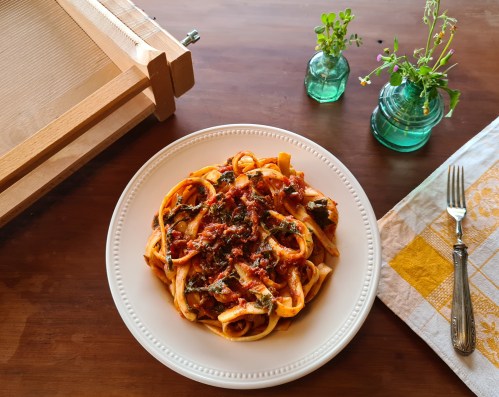 After some thought, the recipe I couldn’t go past is, Maccheroni alla chitarra with wild greens. I’ve known this dish from when I was a little girl, have cooked and eaten it in both Italy and Australia and it has ties to my Abruzzo ancestry going back more than 600 years. It’s also a lovely connection to Bisnonna Maddalena and Nonno Anni recalling her foraging for wild greens on hillsides around Fossa and carrying them in her apron back to the kitchen. (‘Maccheroni’ is the original Abruzzese name used for this dish, while in Italy’s north where maccheroni is a short pasta, it’s called ‘spaghetti alla chitarra’.)
Pictured for the cookbook is my chitarra – made of beechwood and strung with steel wires, which are ‘tuned’ like a guitar. A sheet of fresh pasta is laid across the wires and pressed through with a rolling pin. One side creates thin strands with a square profile, the other side, wider strands, like fettucine, as I’ve made here. In the little vases (old inkpots!) are some edible greens I picked – yes, I went foraging in the backyard, not quite the Abruzzo hillsides but I was amazed how much it yielded (and I double-checked they were safe to eat – dandelion leaves, cobbler’s pegs, purslane among them).
The napkin I chose is one Nanna Francesca brought me back from Italy many years ago and the fork is from a cutlery set bought in L’Aquila in 1970 by a Fossa relative, Pierina who gave it my parents who passed it down to me. Once you start delving into it, it’s incredible how much history can end up in sitting down to a bowl of pasta! 💚🍝 xxx
* An Abruzzo invention, the ‘chitarra’ dates back to at least the 1800s, its ancestor being a rolling pin with notches in it that cut the pasta into the wider strands. (Chitarra may be found in many shops, markets and online.) Will keep you posted when the cookbook is available. 😊

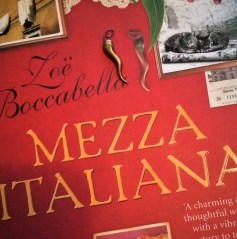
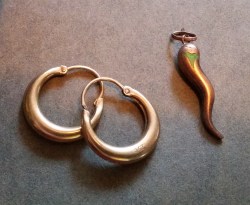 ‘Raccavallala!’ Granny Maddalena cried out if someone stepped over a child lying on the floor – step back over it! – or you’d stunt the child’s growth. I’m currently researching Italian folklore and came across this very superstition and many others like… never put your wallet on the floor or you’ll have no money. If you accidentally put your clothes on inside out in the morning it’s good luck and you’ll receive good news. Wasting food or throwing it out brings misfortune. Remove cobwebs with your left hand for good luck.
 Beside Maddalena’s amulet are her gold earrings – given to young girls as gold was believed to protect against blindness and misfortune and interestingly because it symbolises the sun’s power and masculine energy. I have no idea how old these earrings are but Estella Canziani did paintings of similar earrings worn by peasants in Italy and France that she saw during her travels in the 1900s, including in the area of Abruzzo where Granny lived.
 “La Spagnola” was what Great-Granny Maddalena called the Spanish influenza pandemic. When it reached Abruzzo, she was twenty-five and yet to marry, with a broken engagement behind her, and working in her parents’ butchery and grain mill in Poggio Picenze. She told my father that after the end of World War I, she remembers seeing young soldiers walking across the valley returning home to their mountain villages after years away fighting. (One of them, my Bisnonno Vitale, an Alpini soldier from Fossa, who hated war, she’d marry just a few years later.) Most of these young men were traumatised, many with missing limbs and no help from authorities for them to recover.
 As they returned to their families and small villages, many unknowingly arrived carrying the Spanish flu with them, which tragically caused more loss after their homecomings. It’s no wonder Granny Maddalena didn’t want to talk about this time much. Her father, Emidio, died that same year in 1919 and I’m not certain if it was from la Spagnola, since many doctors put pneumonia or septicaemia on death certificates instead. However, as he was only 61 and his sister and brother aged 60 and 59 both died in 1918, it’s very possible they all succumbed to what was known as the Spanish flu. From 1918 to 1920, 500 million people across the world suffered from the pandemic with the death toll being at least 50 million, though some estimate it closer to 100 million.
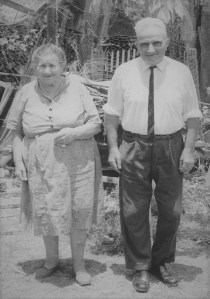
 There are stories across the world from this time of parents warning children to behave or “the Spanish lady will get you” and children’s rhymes that began, “I had a little bird, its name was Enza, I opened the window, and in-flu-enza…” Fortunately such fearsome ways are mostly relegated to history, however, in our present uncertain period, this Australian, 1919 drawing by May Gibbs to help children understand what was happening at the time shows perhaps a gentler way that is almost as relevant today.
 In what is set to continue to be a challenging time in coming months, I wish you forbearance, a little humour when needed, gentleness and care. For me, if there’s perhaps one thing to hold onto, judging by how people have overcome brutal times in the past including some in my own family, it’s that even when confronted by that which may seem almost impossible to face, it is possible to face it and be stronger than you thought you could be.
 Much love, Zoë xx

 Received this lovely gift from a reader, Augusto (who doesn’t mind me sharing that he lives in Australia, was born in Fossa, Abruzzo and was pleased to discover the books). At 80, for the first time he’s learnt copper smithing and made me this little, copper conca and ladle, like those larger ones traditionally used in Abruzzo to collect water (women like my bisnonna Maddalena carried them on their heads).
 Thank you to Augusto, such a beautiful kindness. I will treasure it always! And many thanks to all who’ve connected through messages and letters. It’s such a pleasure to hear from you. What most drives me to write is to preserve experiences of ‘everyday’ people and their often overlooked yet I believe significant parts of history. Thank you for your interest (and I’m working hard on the next book!!) xx
 Walking around Fossa, along lanes that become so steep and narrow they merge into steps or descend into tunnels, I began to notice all the different doors I passed. Some with stylised, door furniture of lion heads or dragons and beautifully varnished wood, others crude, weathered timber, or painted mission brown.

 Zoë Boccabella