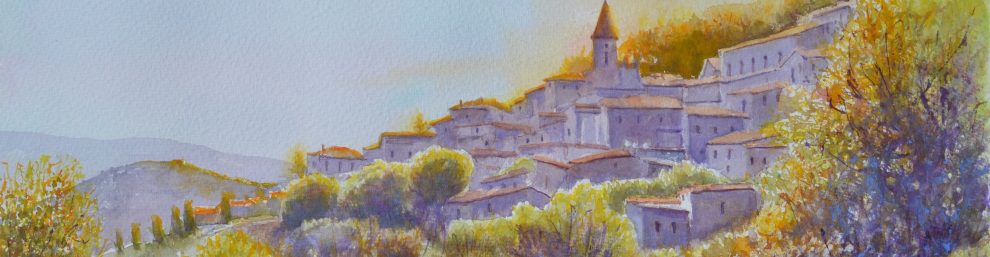
Tonight’s the night Befana comes to visit, leaving children in Italy sweets if they’ve been good and coal if naughty. These days she’s depicted as a ‘witch’ who visits on the twelfth day of Christmas, coming down chimneys to deliver her gifts (and yes, she was about long before a certain jolly fellow). Incredibly, her origins are tied up in Italian folklore for more than two thousand years, and not only that, but with links to Abruzzo.
Initially, Befana was known as Strenua or Strenia, an ancient goddess of the new year for the Sabines in central Italy’s Apennines, and then for the Romans too. As early as 153BC, records show sweet gifts of dates, figs and honey were exchanged in her honour for the coming year and twigs carried from Strenua’s fertile grove in procession.
These ‘twigs’ likely later became a broom when she was morphed into Christianity as an older woman busy sweeping her house when the magi, three wise men stopped by en route to see the new-born Jesus. The ‘sweet gifts’ becoming those Befana gave children after regretting being too busy working to join the magi. She set out later but, unable to find them or the baby Jesus, instead left her gifts for other children.
Over time, Befana became depicted as more witch-like, travelling by broom, her gifts not only sweets but also coal (yet still valuable for heat in winter, a gift shared with all). I’ve a soft spot for witches, especially those who are healers and an integral part of village life. I’m perhaps biased since my Bisnonna Maddalena was one of Fossa’s witches, but I can’t help feeling it’s unfair how these older knowledgeable women over time became portrayed as uglier and uglier, including Befana.

Lessen the hooked nose, pointed chin, warts and pointy hat and the ‘witch’ is a woman, with years of experience behind her. A nonna, mother, aunt, the lady next door – women who’ve aged with grace, hard work and all that happens over time when blessed with a long life. A woman, perhaps familiar, older, living alone, cleaning her house, making sweets as gifts and quite beautiful in her lined face and her kindnesses. A woman like Befana.
Epiphany is still celebrated in many countries around the world and it’s lovely (and quite incredible in a way!) that in Italy, Befana remains a part of it and held close more than two millennia on. Viva, viva la Befana. Buona Epifania! 🌠
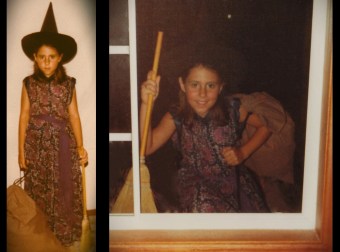 Tonight is Epiphany Eve and in Italy many children will be waiting to see what they receive from La Befana, ‘the witch’ – sweets if they’ve been good, coal if they’ve been naughty. As I wrote in, Mezza Italiana, I was chosen as La Befana for my school play, being ‘an Italian kid’, and as you can see from the first photo, I wasn’t too thrilled about it! 😄 Although, I’d warmed up to the idea by the second photo when I got to climb through a window. (As you can also see, being summer, I’m already a bit burnt from swimming at the local pool!)
 January 6th – Epiphany and the visit of la Befana, the wise men and women and marking the end of 12 days of Christmas. Whatever your beliefs, ‘epiphany’ is a lovely word with connotations of insight, discovery and a sudden understanding of something that is very important to you.
 In another Italian tradition… after learning about Abruzzese pizze fritte – its song and secret recipe handed down from mother-to-daughter (and sometimes son), but only on New Year’s Eve – Roger and I decided to end the year by cooking these.
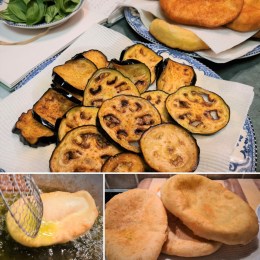 Except, not knowing all of the secret recipe that contains anise and saffron, we decided to make our own version with toppings of basil pesto and crispy prosciutto, bufala di mozzarella, melanzane, tomato and basilico leaves from the garden. The fritte were also cooked in a wok and finished in the oven, which worked well, but isn’t quite traditional! Yet they were delicious and I loved thinking about their connection with Abruzzo.
 If it otherwise means not following a tradition at all because it’s too hard or the recipe is lost, perhaps it’s okay to adapt them at times. For that becomes part of our history too, all of us adapting here and there along the way over the years, while still understanding what is important overall. Tanti auguri di felicità per l’Epifania! Many wishes of happiness for Epiphany! xxx

 Zoë Boccabella