
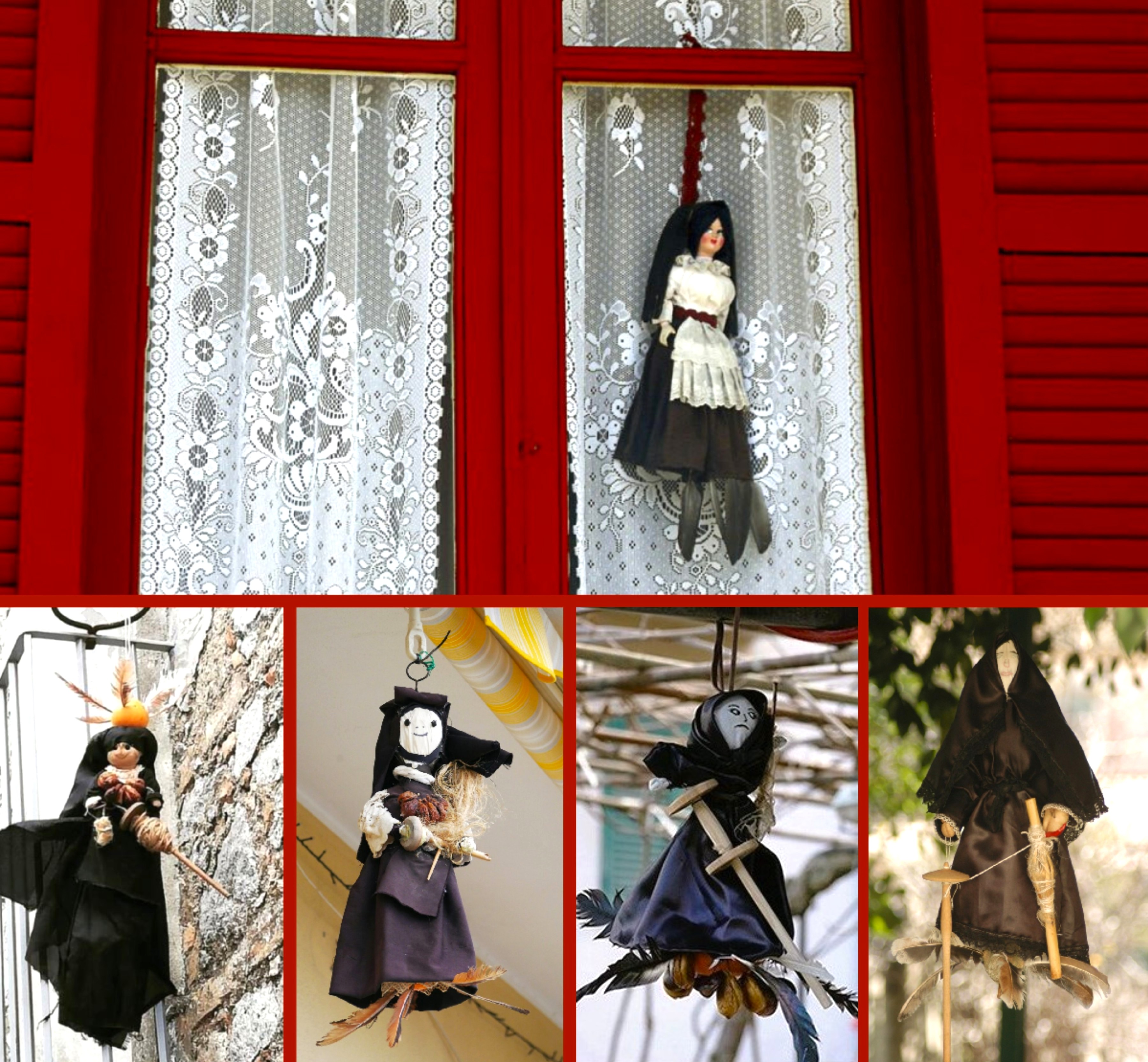
Corajisima – ‘the widow of Martedì Grasso’ (the last day to eat all you want before abstaining during Lent). Then, from midnight, Corajisima roams the streets with boiling water to burn the throats of whoever dares to eat meat or sweets.
In southern Italy, hanging a handmade Corajisima effigy in windows or at doors is to remind it’s currently the Christian Lenten ritual of fasting and sacrifice and she’s come to appear as a skinny, old, ugly woman in black with feathers, fruit and a spindle.
However, originally, she was quite different. Since ancient times the effigy of a woman with fruit, feathers and spinning tools has been used in both old, Italian folklore and paganism to symbolise transformation and the earth reawakening. A lovely, comforting figure to encourage perseverance until the full arrival of spring.
I happen to have a doll (just like the one in the pretty red-painted window with its lace curtain) that Nanna Francesca gave to me as a child (yes, this doll is still in my cupboard!) Yet, Corajisima and this tradition wasn’t carried on after she and her mum emigrated from Calabria to Australia and it’s sobering to think of emigration ending a tradition so very old. Perhaps come spring in Australia, I should bring out this doll and find some feathers and a spindle?! (Spindles were a big deal in Abruzzo folklore too.)
Whatever might be thought of these old rituals, to me there is something quite incredible in how they’ve survived thousands of years, to evolve or be hijacked, yet are still ongoing. And it’s wonderful to think this one was originally a figure to encourage perseverance until the arrival of better times, a time of transformation and reawakening. ❤️🍊🧵🌿


 Zoë Boccabella
Really enjoyed this. Didn’t know anything about these dolls.
Thank you, Rosemary, it amazes me just how many old rituals Italy has and how far back they go! xx